Over the past few weeks, I’ve spent hours in conversation with senior finance leaders across our network, alongside listening to expert panels at our recent advisory workshops and CFO roundtables.
If there is one word that captures the current boardroom mood, it is uncertainty.
But this isn’t the kind of cyclical economic uncertainty finance leaders are used to navigating.
This is structural. It is driven by the unprecedented pace of Generative AI, and the uncomfortable reality that we have reached a genuine technological inflection point with no clear blueprint for what comes next.
The Technology Freeze
According to Gartner, over 60% of CFOs are now accelerating investment in AI, yet paradoxically, many are simultaneously delaying large-scale technology commitments due to fear of rapid obsolescence.
We are seeing this tension play out in real time.
At a recent AI in Finance roundtable, following a live demonstration of how large language models can automate multi-scenario modelling and variance analysis, one finance leader admitted they were immediately pausing a significant planned investment in a traditional data visualisation platform. Their logic was simple: why commit to a fixed architecture when AI can dynamically interpret raw data in real time?.
This hesitation is backed up by our 2025 Finance & Accounting Market Insight Guide released in January. Having surveyed over 2,500 finance leaders, we found that 68% of businesses have allocated only 0-25% of additional budget to technology investments this year. The message from software vendors and boards alike is identical. Companies are incredibly hesitant to enter 3 to 5 year enterprise agreements when the underlying technology landscape is evolving in six-month cycles.
The question being asked more frequently in boardrooms is: Why sign a five-year contract for a solution that may be obsolete in two?.
The Talent Paradox: You Can’t Hire What Doesn’t Exist
This technological uncertainty is completely reshaping executive search and talent strategy.
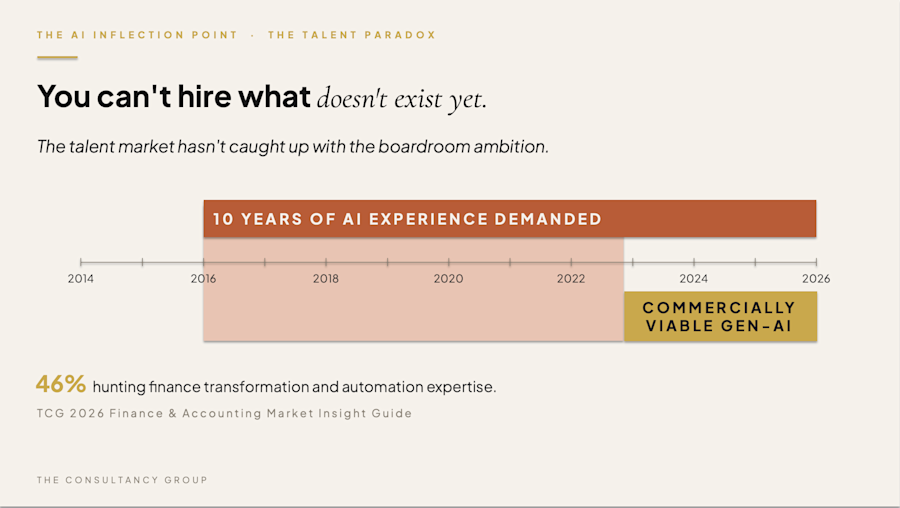
Our data reveals a staggering shift. 62% of businesses are demanding business partnering skills, while 46% are hunting for finance transformation and automation expertise.
We are increasingly being briefed on mandates for roles such as Head of FP&A or Finance Transformation Director, where “proven AI experience” is listed as a non-negotiable requirement.
But here is the reality: the talent market hasn’t caught up with the ambition. Boards are asking for a maturity of experience that hasn't had time to develop.
You cannot hire someone with a decade of experience in a capability that has only been commercially viable for a fraction of that time.
Hiring for the Curiosity Mandate
So how do you build a finance function for a future you can’t clearly define?
The most forward-thinking organisations are shifting their lens. Recently, I took a brief for two senior Finance Director mandates within a business with a strong transformation agenda.
Crucially, the hiring manager recognised that searching for a fully formed “AI expert” would be both unrealistic and limiting.
Instead, the defining requirement was curiosity.
Not curiosity as a soft trait, but as a strategic capability. They were looking for leaders who:
Actively experiment with emerging tools rather than waiting for maturity.
Can translate ambiguous technological potential into commercial outcomes.
Are comfortable making decisions with incomplete information.
Can evolve operating models in parallel with technological change.
In other words, leaders who can learn faster than the environment changes.
The Path Forward
We are entering an era where certainty is no longer a competitive advantage. Adaptability is.
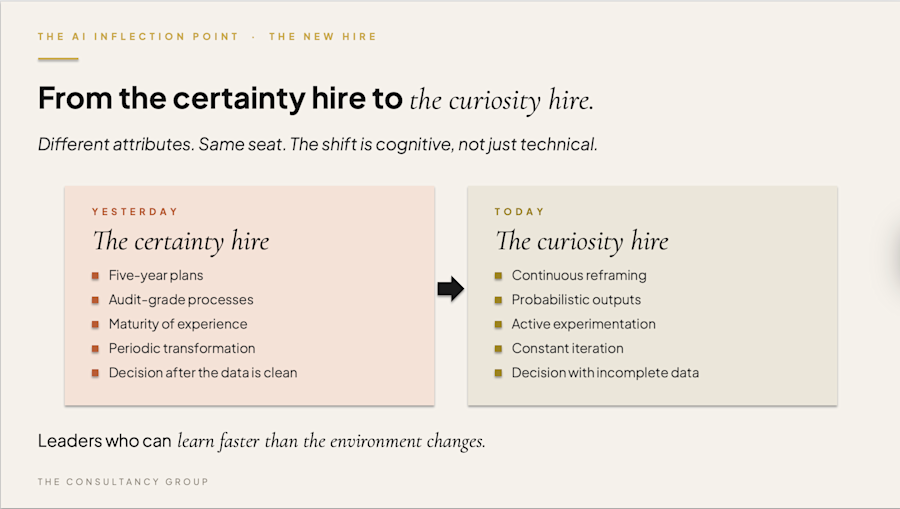
The finance leaders who will define the next decade won’t be those with the most detailed five-year plans, but those who can continuously reframe them. They will be operators who can diagnose capability gaps in real time, balance experimentation with financial discipline, and lead teams through constant iteration, rather than periodic transformation.
Because in a world where the tools are evolving monthly, the only sustainable advantage is how quickly your people can evolve with them.
If your organisation is rethinking how to structure its finance function for the AI era, or assessing whether your current leadership team is equipped for what is coming next, the conversation starts here. Get in touch to explore the data shaping the market.